

“You don’t need to rent a car in Australia, the trains and tour buses will take you everywhere worth seeing.”
Australia is enormous. The country covers roughly 7.7 million square kilometres, which is close to the size of the continental United States, yet the population is concentrated in a handful of coastal cities. That single fact shapes everything about how you should travel here, and it is exactly why so much of the standard travel advice falls apart the moment you land. Below are five stubborn myths about seeing Australia without a car, and what actually happens when you test them against reality.
Myth 1
Myth: Public transport can get you to all the best places
On paper, the map looks reassuring. Sydney has trains, Melbourne has trams, and every capital has a bus network. What the map does not show is that the highlights, the coastal lookouts, the wineries in the Margaret River region, the beaches south of Perth, the trailheads inside Kakadu National Park are rarely near a train station. Regional bus services exist but usually run once or twice a day, and they stop at town centres, not at the viewpoint you actually came for.
The reality is that public transport in Australia is designed for commuters going to work, not for travellers chasing scenery. A day trip that takes forty minutes by car can easily become a five-hour ordeal on buses, if the connection exists at all. With a rental you decide when to leave, where to stop, and how long to linger. If you are flying into Perth to explore the west coast, picking up a hire car in Perth at the airport is usually the single decision that unlocks the rest of the trip.
Myth 2
Reality: The coast is meant to be driven, not glimpsed

The Great Ocean Road in Victoria is 240 kilometres of cliffs, rainforest, and surf beaches. The Pacific Coast between Sydney and Brisbane threads through fishing villages, national parks, and headlands. The Indian Ocean Drive north of Perth passes the Pinnacles and long stretches of empty white sand. None of these routes work as a one-shot tour bus experience. They work as slow drives with unplanned stops.
Pull over when a lookout appears. Take the side road when a sign points to a waterfall. Skip a town if the weather turns. That flexibility is the whole point, and it is impossible on a scheduled service.
Myth 3
Myth: National parks are easy to reach without a car
Many of Australia’s most rewarding national parks, Kalbarri, Karijini, Grampians, Freycinet, Cape Le Grand, sit hours from the nearest town of any real size. A small number of the most famous parks, Uluru-Kata Tjuta and parts of the Blue Mountains, are served by organised tours. The rest expect you to arrive under your own power.
What that means in practice
- Trailheads open early, and the good light is at sunrise, which no bus timetable respects
- Camping grounds inside parks have no shuttle service
- Some park roads are unsealed and require a higher-clearance vehicle
- Weather can close routes, and only a driver can reroute in real time
Myth 4
Reality: The right car changes the trip completely
One reason rental gets a bad reputation is that people book the wrong vehicle. A tiny hatchback is fine for a weekend in Melbourne and miserable on a three-week loop with two kids and a boot full of gear. Match the car to the trip and everything becomes easier.
Convertible
Best for coastal drives where the point is the view, the sea air, and short distances between stops. Ideal for couples on the Great Ocean Road or the Sunshine Coast.
Crossover or SUV
The all-purpose choice. Handles long highway stretches comfortably, copes with the occasional gravel road into a national park, and swallows luggage without complaint.
Large SUV or people mover
The family answer. Room for prams, eskies, boogie boards, and a week of clothes. Also more relaxed on long inland drives where the scenery is beautiful but the distances are long.
Myth 5
Myth: Driving in Australia is too intimidating for visitors
Australia drives on the left, which sounds daunting until you have done it for half a day. Roads are generally well maintained, signage is in English, and outside the CBDs the traffic is light by international standards. The main things to respect are distance, fatigue, and wildlife at dawn and dusk. Plan sensible daily drives, stop often, and avoid remote roads after dark, and the country becomes very drivable.
A quick sanity check before you set off:
- Confirm your licence. Most overseas licences in English are accepted, otherwise carry an International Driving Permit.
- Keep left, overtake right. Give yourself a quiet suburban loop on day one to settle in.
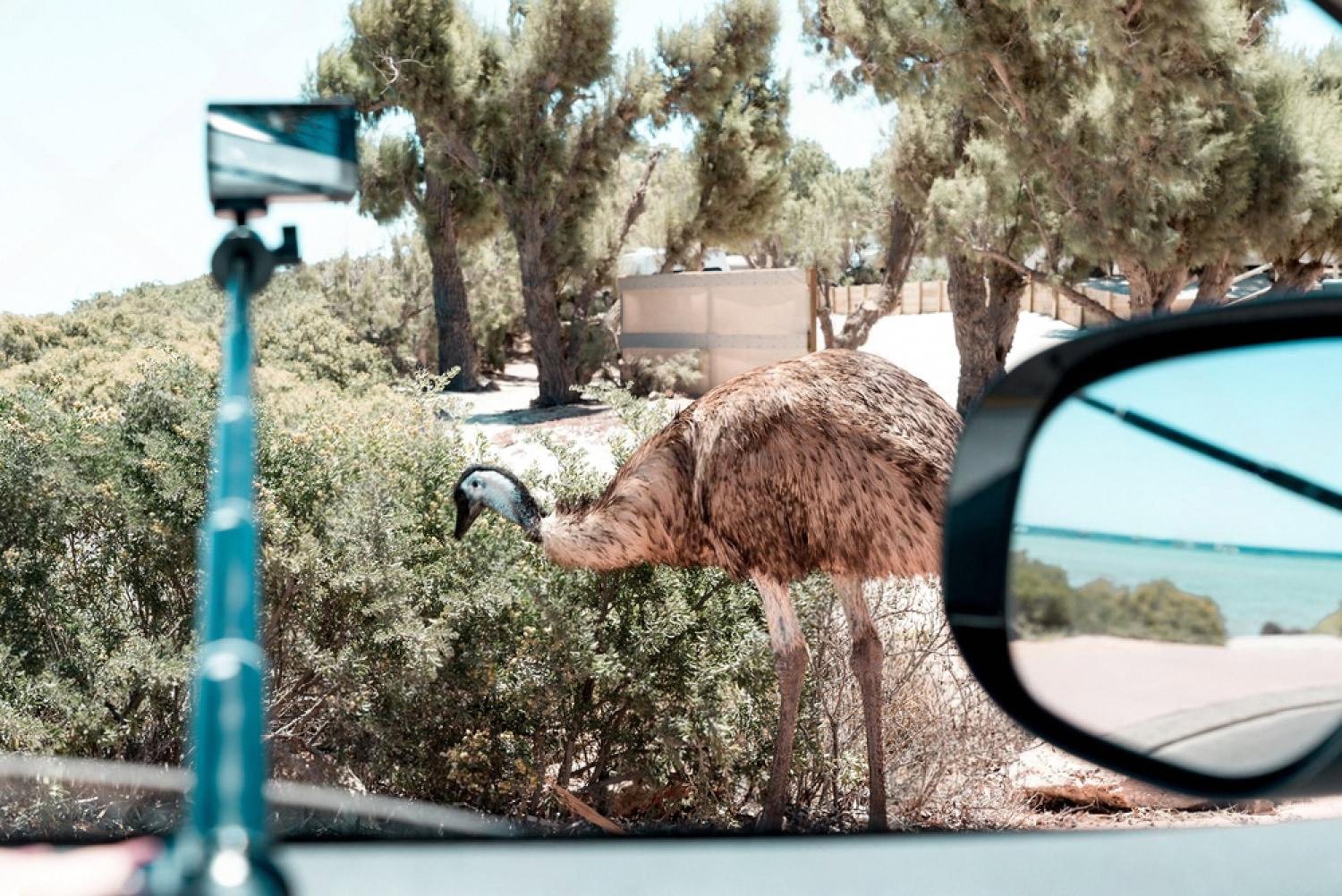
- Watch for kangaroos and emus near the roadside, especially outside major towns.
- Fuel up in towns. Distances between service stations can stretch further than you expect in the interior.
So what does this actually look like on a trip?
Picture a week starting in a capital city. Morning coffee in town, then a drive along the coast with the windows down, a swim at a beach the tour buses skip, lunch at a bakery in a country town, an afternoon walk in a national park, and a quiet evening at a small hotel you chose because the light looked good from the road. None of that survives a fixed schedule. All of it becomes normal once you have your own car.
Frequently asked questions
Do I need an International Driving Permit to rent a car in Australia?
If your driver’s licence is in English and current, most Australian rental companies will accept it directly. If your licence is in another language or script, you will need to carry an International Driving Permit alongside your home licence. Either way, keep both documents on you while driving.
What is the minimum age to rent a car in Australia?
Most major rental companies rent to drivers aged 21 and over, with a standard licence held for at least one year. Drivers under 25 usually pay a young driver surcharge and may be restricted from certain vehicle categories, such as large SUVs and premium models. Check the specific supplier’s terms before booking.
Is it safe to drive long distances in the Australian outback?
It can be, provided you prepare properly. Carry extra water, tell someone your route, avoid driving between dusk and dawn because of wildlife, and refuel at every town you pass. Mobile coverage disappears quickly once you leave the coast, so download offline maps and consider a satellite communicator for very remote stretches.
Should I choose a convertible, a crossover, or an SUV?
Match the car to the trip. A convertible is a treat on short coastal drives with light luggage. A crossover suits couples or small families doing a mix of highway and light gravel. A large SUV or people mover is the right call for families with children, camping gear, or multi-week itineraries where comfort on long drives matters more than fuel economy.
Can I take a rental car between Australian states?
Yes, almost all rental agreements allow interstate travel on sealed roads. What is usually restricted is one-way drop-off in a different city, which attracts a relocation fee, and driving on unsealed or 4WD-only tracks, which may void insurance. Read the fine print, particularly if you plan to cross into the Northern Territory or Tasmania.
How far in advance should I book?
For school holidays, Christmas, Easter, and the June and September breaks, book two to three months ahead. Popular categories such as large SUVs and campervans sell out first and prices rise sharply close to the date. Outside peak periods, two to four weeks is usually enough to get a fair rate on the vehicle you actually want.

Soccer lover, feminist, DJ, hand letterer and New School grad. Operating at the fulcrum of aesthetics and programing to create strong, lasting and remarkable design. Let’s make every day A RAZZLE-DAZZLE MUSICAL.